Not all basmati rice packages tell the truth. Some hide poor ageing behind bold branding. Others skip grain details that actually matter.
Buying good basmati rice starts before you ever cook a single grain. It starts at the shelf — reading the package correctly, spotting the right details, and ignoring the marketing noise. Get this step wrong, and you risk broken grains, stodgy texture, or a biryani that falls flat. Get it right, and every batch delivers the long, fluffy, separate grains basmati is known for.
Here’s exactly what to check before you buy.
Why Checking Basmati Rice Packaging Matters
Packaging is your only window into quality before purchase. You can’t smell the aroma or test the grain length in-store. The label has to do that work for you.
A clear, honest basmati rice package gives you three things: the variety, the processing method, and proof of quality. Missing any one of these is a red flag.
Check the Variety Name — Not Just “Basmati”
“Basmati” alone tells you almost nothing. Dozens of varieties fall under that name, and each performs differently in the pot.
Look for the specific variety printed on the pack. Strong examples include:
- 1121 variety — known for exceptionally long grains, often extending past 8mm after milling. See it in 1121 White Basmati Rice.
- Golden Sella — parboiled for a firmer bite and golden hue, found in 1121 Golden Sella Basmati Rice.
- Steam processed — treated before milling to hold shape under high heat, as with 1121 Steam Basmati Rice.
No variety name on the pack means no accountability for grain performance. Skip it.
Look For Ageing Duration
Ageing makes or breaks grain quality. Freshly milled basmati rice cooks sticky and breaks easily. Properly aged rice — 12 months or longer — holds its shape, elongates cleanly, and separates after cooking.
Few brands print exact ageing duration on the package. That’s a problem worth noticing, not ignoring. If the label stays silent on ageing, ask directly before you buy. A supplier confident in its process will tell you. Check About Us for an example of how ageing and sourcing practices should be communicated.
Verify Grain Length and Appearance Claims
“Extra-long grain” means nothing without a number attached. Genuine long grain basmati rice measures well beyond standard rice — often 7mm or more before cooking, extending further once boiled.
Here’s a quick way to check the package against reality:
| Package Claim | What To Verify |
| “Extra-long grain” | Look for a stated length in mm, not just the phrase |
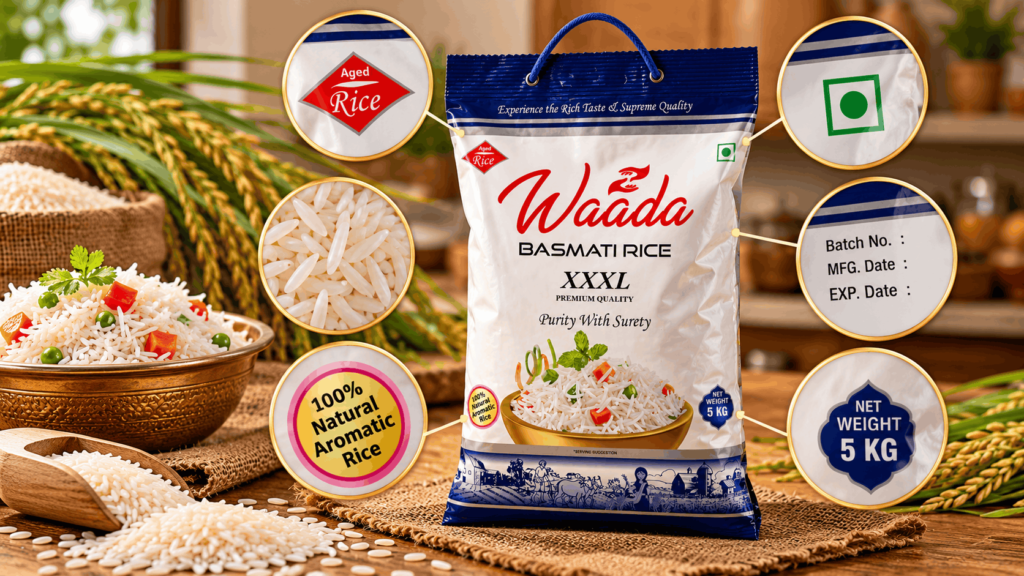
| “Aged rice” | Check for a stated ageing period (12+ months is standard for quality) |
| “Premium quality” | Cross-check with variety name — premium claims without a named variety carry no weight |
| “Naturally aromatic” | Should pair with variety details like 1121 or traditional basmati stock |
Rice like Long Grain White Basmati Rice and XXXL Basmati Rice back up length claims with milling precision — grain integrity preserved, not polished away.
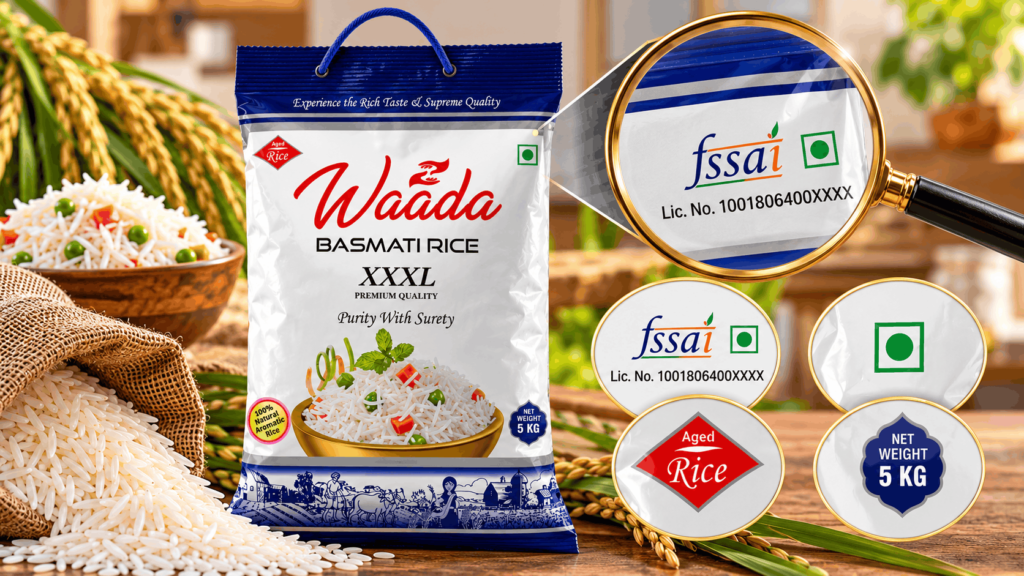
Check for FSSAI Registration and Quality Marks
Every legitimate basmati rice package sold in India carries an FSSAI license number. No number, no guarantee of food safety compliance.
Beyond FSSAI, check for:
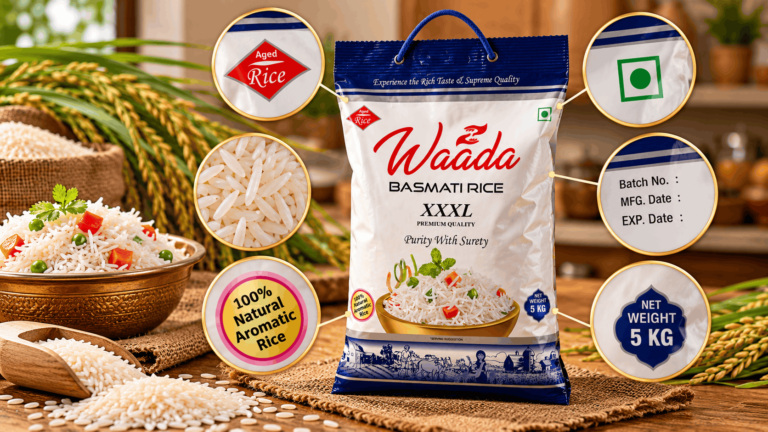
- Batch or lot number — proof of traceability.
- Manufacturing and packing date — fresher packaging dates mean better stock rotation.
- Net weight clearly stated in grams or kilograms, matching what you’re paying for.
These details are small. They are also non-negotiable. Skipping them means buying on trust alone, with no way to verify anything later.
Watch for Vague or Unverifiable Claims
Words like “premium,” “finest,” or “export quality” sound convincing. They prove nothing on their own.
A trustworthy basmati rice package backs every claim with a specific detail — variety name, ageing period, grain length, or certification. If a label leans entirely on adjectives without facts, treat that as a warning sign, not reassurance.
Specialty varieties deserve a closer look too. Black Berry Basmati Rice, for instance, carries a naturally pigmented bran layer. That’s a variety trait, not a processing defect — but only a package with clear variety labelling tells you which is which.
Buy Basmati Rice with Facts, Not Guesswork
A good basmati rice package earns your trust with specifics — variety, ageing, grain length, and certification, stated clearly. Anything less puts the burden on you to guess what’s actually inside the bag.
Waada labels its rice range with exactly these details, from long grain whites to golden sella and specialty varieties. Browse the full basmati rice product range to compare options directly, or reach out through Contact Us for guidance on choosing the right pack for your kitchen.